

Welsh Corgis require 1-1.5 cups of high-quality dry food daily for adults, split into two meals, while puppies need more frequent feedings based on age. Adult Corgis typically weigh 22-30 pounds and need 600-900 calories per day depending on activity level. Puppies from 8-12 weeks old require 3-4 meals daily, with portions calculated as 4-5% of their body weight, gradually transitioning to adult portions by one year of age.
Proper portion control prevents obesity, a major health concern for this breed. For comprehensive breed information, visit the Welsh Corgi resource center.
- Adult Welsh Corgis typically need 600-900 calories daily, met with 1-1.5 cups of high-quality dry food split into two meals.
- Puppy feeding schedules vary by age: 3-4 meals daily at 8-12 weeks, transitioning to 2 meals by 6 months, with portions at 4-5% of body weight initially.
- Obesity is a major health risk for Corgis; use the rib test to monitor body condition and avoid free-feeding to prevent hip and spinal issues.
Welsh Corgi Portion Sizes: Exact Amounts by Age and Weight
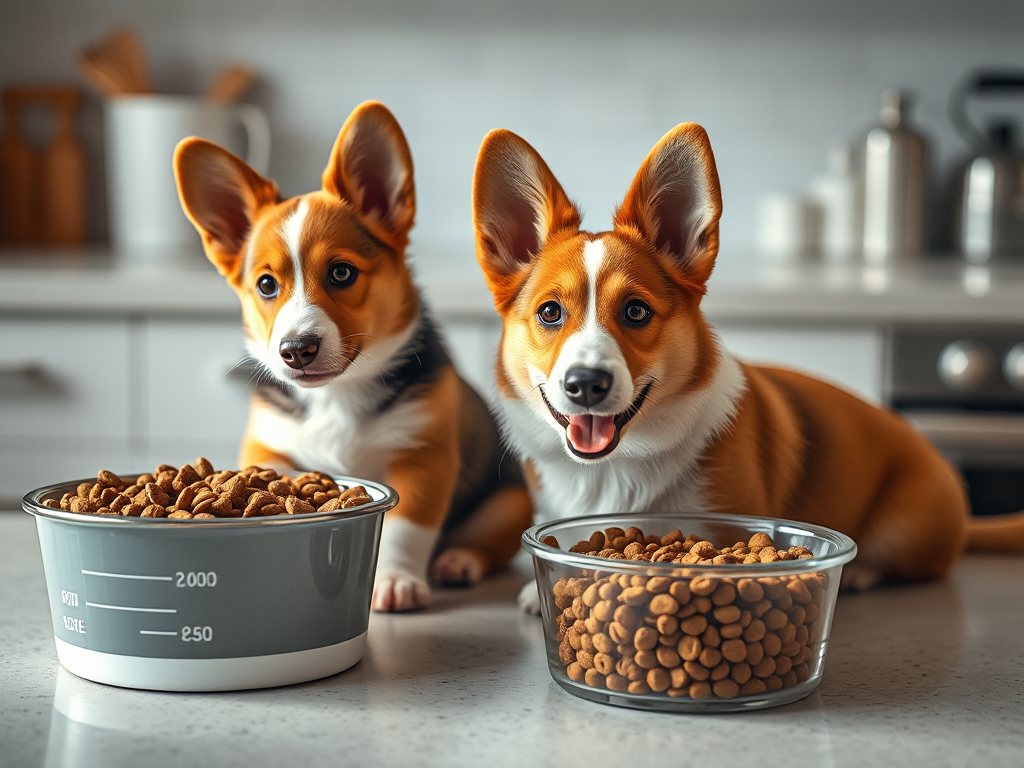
Adult Corgi Feeding: 1-1.5 Cups Daily, Split into Two Meals
Adult Welsh Corgis have specific daily food requirements based on their weight and activity level. The standard feeding guidelines are:
- Total food: 1 to 1.5 cups of high-quality dry food
- Per meal: 1/2 to 3/4 cup, served twice daily
- Calories: 600-900 kcal for active adults; 350-550 kcal for moderate activity
- Weight: 22-30 pounds (10-14 kg) is the breed standard
These numbers are starting points only. Your individual Corgi may need adjustments based on age, metabolism, and activity level. The most critical factor is calorie density, which varies significantly between dog food brands.
For instance, one cup of kibble might contain 300 kcal while another contains 450 kcal. Always check the feeding recommendations on your specific food’s packaging rather than relying solely on cup measurements.
This ensures your Corgi receives appropriate nutrition without risk of overfeeding. When selecting a high-quality dry food, refer to the vet-recommended dog food for Welsh Corgis to ensure optimal nutrition.
Puppy Feeding Schedule: Meal Frequency from 8 Weeks to 6 Months
Welsh Corgi puppies need more frequent meals than adults to support rapid growth and prevent hypoglycemia. Follow this age-based schedule:
1. 8-12 weeks: Feed 3-4 meals per day. Puppies this small have limited stomach capacity and high energy needs.
Frequent meals maintain stable blood sugar levels.
2. 12-24 weeks: Transition to 3 meals per day. As the puppy grows, stomach capacity increases.
Some owners feed 3 meals during this period before moving to 2 meals.
3. 6 months and older: Switch to 2 meals per day, the standard adult schedule. This aligns with the dog’s mature digestive system and helps maintain a consistent routine.
4.
At 1 year: Transition to adult dog food and adult portion sizes. Puppy food is formulated for growth; continuing it past maturity can lead to weight gain.
Real-world example: A Reddit user with a 4.5-month-old Corgi feeds 1/4 cup three times daily, reserving an additional 1/4 cup throughout the day for training treats. This demonstrates the flexibility needed as puppies grow at different rates. For optimal development, choose a nutrient-dense puppy formula, such as those in best puppy food for Corgis guides.
Puppy Portion Calculations: Percentage of Body Weight by Age
Instead of fixed cup measurements, puppy portions are best calculated as a percentage of current body weight. This method scales appropriately as the puppy grows rapidly.
| Age Range | % of Body Weight to Feed | Example (10 lb puppy) | Example (20 lb puppy) |
|---|---|---|---|
| 24-36 weeks | 4-5% | 0.4-0.5 lb (6.4-8 oz) | 0.8-1.0 lb (12.8-16 oz) |
| 36-56 weeks | 3-4% | 0.3-0.4 lb (4.8-6.4 oz) | 0.6-0.8 lb (9.6-12.8 oz) |
These percentages apply to dry food. Raw feeding typically uses about 2% of body weight. Puppies require higher nutrient density than adults, so choose a high-quality puppy formula.
Refer to growth charts to estimate your puppy’s expected adult size and adjust portions accordingly. For instance, a Corgi puppy typically weighs 9-14 lbs at 3 months and 14-20 lbs at 5 months according to Pawlicy’s 2026 growth data. Monitor your puppy’s body condition weekly—you should see a waistline when viewed from above and be able to feel but not prominently see the ribs.
Why Are Cup Measurements Misleading for Corgi Feeding?
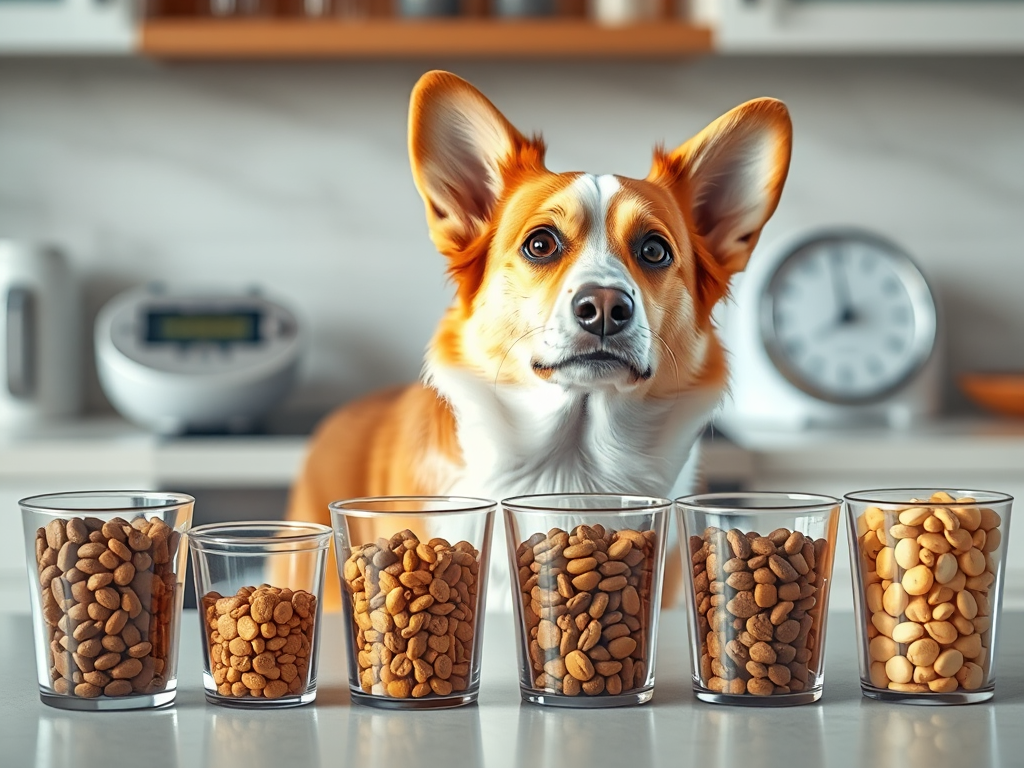
Calories Over Cups: Reading Dog Food Labels for Accurate Portions
Cup measurements are volumetric and do not account for calorie density differences between dog food brands. One cup of a low-calorie kibble might contain 300 kcal while another contains 450 kcal. This variance means feeding the same volume can result in 50% more or fewer calories.
Purina emphasizes that “dog feeding amounts vary from product to product based on calorie content and formula,” advising owners to “consult the feeding chart on the back of your dog’s food packaging.” PetMD’s adult feeding chart illustrates this: for a 21-35 lb dog, recommended portions range from 1⅔ to 2⅓ cups depending on the food’s caloric density. To ensure accurate nutrition, always prioritize calorie targets over cup measurements. Calculate your Corgi’s daily calorie needs first, then use the specific feeding guide for your chosen food to determine the exact cup amount.
This discrepancy is particularly important for Corgis due to their propensity for weight gain. A seemingly small overage of 100 kcal daily can lead to significant weight gain over months. Therefore, responsible Corgi owners must become proficient at reading dog food labels.
Look for the kcal/cup value, which is usually listed near the guaranteed analysis. Then, divide your dog’s target daily calories by this number to get the precise cup measurement. For example, if your adult Corgi needs 600 kcal daily and your food contains 300 kcal per cup, you would feed 2 cups total.
If the same food had 400 kcal per cup, you’d only need 1.5 cups. This method eliminates guesswork and ensures consistent, appropriate feeding.
Activity Level Adjustments: From 350 to 900 Daily Calories
Your Corgi’s activity level dramatically impacts caloric needs. Use these general guidelines:
- Sedentary: 350-450 calories daily. Applies to senior dogs, those with mobility limitations, or Corgis confined to small spaces with minimal exercise.
- Moderate activity: 450-600 calories. Most pet Corgis fall here with daily walks and playtime. Marleybones (2026) reports that “most adult Pembroke Welsh Corgis need between 350 and 550 calories a day” for this level.
- Active: 600-900 calories. For Corgis engaged in regular herding, agility, hiking, or intense play. These dogs may require up to 3% of their body weight in food.
Assess your dog’s activity by observing energy levels, willingness to exercise, and muscle tone. An under-exercised Corgi may become bored and destructive, while an over-fed sedentary dog quickly becomes overweight. Alternatively, some owners use the percentage-of-body-weight method: feed 2-3% of ideal body weight for maintenance, adjusting up or down based on activity and body condition.
This approach simplifies portioning when switching between foods with different calorie densities. Remember that “activity” includes not just structured exercise but also spontaneous play, mental stimulation, and household movement.
A Corgi that actively participates in family life, climbing stairs and playing with children, burns more calories than one that rests quietly. Re-evaluate your dog’s activity level every few months, as needs change with age, health status, and seasonal variations.
Weight Management: Preventing Obesity in Corgis
What Is the Ideal Weight for a Welsh Corgi? Breed Standards vs. Individual Variation
Determining the ideal weight for a Welsh Corgi involves balancing breed standards with individual variation:
- Breed standard: 22-30 pounds (10-14 kg) for adult Pembroke Welsh Corgis. This range accommodates most healthy dogs.
- Frame size matters: Some Corgis have larger bone structures and may weigh up to 40 pounds while remaining lean. The key is body condition, not the scale number.
- Body condition scoring: More reliable than weight alone. You should be able to feel but not prominently see the ribs. A visible waistline should exist when viewing from above.
- Overweight protocol: If your Corgi exceeds 30 pounds, reduce daily intake to 2-3% of ideal body weight and monitor closely. Excess weight strains the long spine and predisposes to IVDD.
Avoid comparing your Corgi to others; focus on maintaining a healthy, muscular physique with minimal fat covering. The breed standard, established by kennel clubs, describes the ideal proportions for show dogs. However, pet Corgis may naturally fall outside this range without being unhealthy.
Genetics, diet history, and activity level all influence adult size. A large-framed Corgi weighing 38-40 pounds with visible muscle definition and a tucked abdomen is in better condition than a 28-pound dog with a potbelly and fat-covered ribs.
Therefore, regular body condition checks are essential. Use both weight trends and physical assessment to guide feeding decisions.
Is 40 Pounds Heavy for a Corgi? Body Condition Scoring Explained
A weight of 40 pounds is not inherently heavy for a Welsh Corgi—it depends entirely on body condition. Some Corgis have larger frames and can carry 40 pounds as lean muscle mass. The critical question is: Is the dog fat or fit?
The rib test provides a reliable answer. Place both thumbs along your Corgi’s spine, with fingers splayed over the ribcage. You should be able to easily feel each rib beneath a thin layer of fat, but not see them protruding.
If you cannot feel the ribs at all, the dog is overweight. If ribs are highly visible, the dog may be underweight. This method, recommended by veterinarians and experienced Corgi owners, is more accurate than weight alone because it accounts for body composition.
A 40-pound Corgi with easily palpable ribs and a defined waist is at a healthy weight, while a 30-pound Corgi with fat-covered ribs is overweight. Regular scoring—monthly for adults, weekly for puppies—helps maintain optimal condition and prevents obesity-related health issues like hip dysplasia and intervertebral disc disease.
Treats and Obesity Prevention: Why Free-Feeding Is Dangerous
Free-feeding—leaving food available at all times—is particularly risky for Corgis due to their hearty appetites and tendency to overeat. Follow these guidelines:
- Why free-feeding fails: Corgis lack an innate ability to self-regulate food intake. Constant access leads to gradual weight gain that often goes unnoticed until significant.
- Treat budget: All treats should not exceed 10% of daily calories. For a 600-calorie diet, that’s only 60 calories—approximately one small training treat or a few pieces of kibble.
- Smart treat strategy: Reserve a portion of your Corgi’s daily kibble allocation for training rewards. This avoids extra calories while still enabling positive reinforcement.
- Health stakes: Obesity in Corgis is not merely cosmetic. Excess weight increases stress on the spine, accelerating degenerative disc disease. It also contributes to hip dysplasia, arthritis, and reduced lifespan. Scrumbles.co.uk warns that “Corgis are prone to weight gain, so portion control and a balanced diet are essential.”
Maintain strict meal times and measure portions precisely to keep your Corgi at a healthy weight. Remember that treats, table scraps, and even healthy snacks like carrots add up quickly for a small dog. Always account for these extras by reducing the main meal portions accordingly.
Perhaps the most counterintuitive insight about Corgi feeding is that a 40-pound dog can be perfectly healthy if it has a large frame and low body fat. Many owners panic when their Corgi exceeds the 30-pound breed standard, but body condition matters more than the number on the scale. The rib test remains your most reliable tool—not the bathroom scale.
Today, perform this simple check: place your hands on your Corgi’s sides and assess rib prominence. If you cannot easily feel the ribs, reduce daily portions by 10-20% and recheck in two weeks. Consistent monitoring prevents the slow, steady weight gain that leads to costly and painful health issues.
Remember: you control your Corgi’s food intake entirely. Unlike humans, dogs cannot choose healthy portions for themselves. Your vigilance ensures a lean, energetic companion ready for herding, hiking, or couch cuddles for years to come.